Pitched Roofing AcrossTayside & Fife —Traditional Craft. Modern Standards.
Slate and tile pitched roofs installed and restored by qualified roofers — traditional Scottish techniques, modern breathable underlays and dry-fix systems, manufacturer-backed warranties and a 25-year guarantee on full re-roofs on full installations.
Heritage & modern spec · 25-yr workmanship guarantee · Fully insured
Pitched Roofing — what it covers and when it's right.
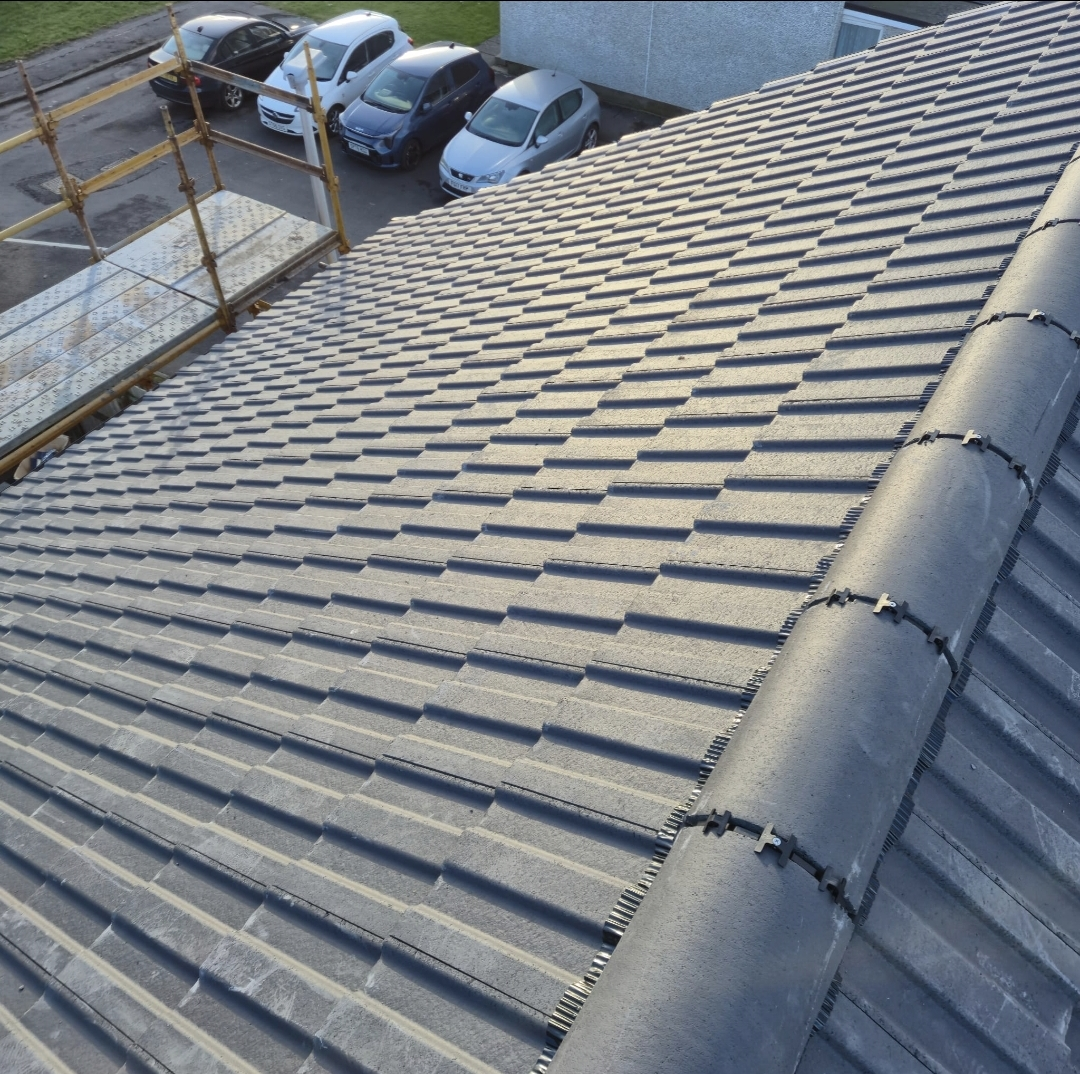
A pitched roof is any roof above 10° — the traditional Scottish shape. Pitched roofing covers new builds, full re-roofs, partial re-covers and restoration of slate and tile roofs to BS 5534 and good heritage practice.
Homeowners with traditional Scottish properties, new-build owners commissioning bespoke designs, landlords and commercial owners with industrial pitched roofs, and anyone managing listed or conservation buildings.
New extensions and builds, end-of-life re-roofs, post-storm repairs, heritage restoration, and partial re-covers (one slope at a time where budget dictates).
Pitched roofing is unforgiving — wrong fixings, wrong nail metal, wrong lap, wrong underlay and you've got a roof that fails in 10 years instead of 80. The skill is in knowing the local building stock and the wind/exposure zone. Tayside is Wind Zone 4–5; specifications from southern England spec sheets routinely fail here.
The cost of ignoring it always exceeds the cost of fixing it.
Wind uplift failure
Tayside coastal sites have failed roofs across whole streets when installers used southern-spec fixings. Cost to replace: in writing on request per house, often refused by insurers.
Nail sickness
Galvanised nails in coastal air rust through in 30–40 years. Every slate then slips one by one. Re-nailing isn't an option — only re-roofing.
Underlay failure
Old 1F bitumen felt becomes brittle and tears under any movement. The roof leaks even when the slates look fine.
Ridge mortar washout
Sand-and-cement ridges fail in driving rain. Loose ridge tiles become wind missiles.
Heritage non-compliance
Wrong slate, wrong mortar, wrong detailing on listed properties triggers enforcement action and forced removal at owner's cost.
Common mistakes we get called to fix
Most of these started as someone trying to save a few hundred pounds.
- Specifying minimum lap rather than Tayside wind-zone lap
- Using galvanised nails on coastal properties
- Re-bedding ridges in cement when dry-fix is a manufacturer-warranted alternative
- Reusing tired old battens under new slates
- Skipping ventilation upgrades during a re-roof — guaranteed condensation and timber rot
A five-step system — no surprises.
Step 1 — Survey & spec
We assess pitch, exposure, condition, listed status and existing materials. Specification matched to wind zone and heritage requirements.
Step 2 — Written quote
Itemised: underlay, batten size, slate/tile spec, ridge system, flashings, ventilation. Valid 30 days.
Step 3 — Scaffold & strip
Scaffold to safe working platform, old covering stripped, structure inspected, defective timbers replaced.
Step 4 — Install to BS 5534
Breathable underlay, treated battens at calculated gauge, slates/tiles laid double-lap, copper or stainless nails, dressed lead flashings.
Step 5 — Sign-off & warranty
Joint inspection, gutters cleared, site cleaned, written guarantee up to 25 years.
What you actually get when you hire Rossi.
80–120 year lifespan
Natural slate properly installed is generational. Concrete tile 50–60 years. Both far exceed mortgage term.
Wind-zone correct fixings
Specified for Tayside exposure — not generic English spec. The single biggest reason our roofs don't fail in storms.
Heritage-appropriate work
Trained in Scottish slate techniques. We're trusted by conservation officers in Perth, St Andrews and Cupar.
Dry-fix ridge & verge
Mechanical systems supplied with the manufacturer's warranty — no more mortar failure.
Energy upgrades included
Loft insulation upgrade offered during every re-roof — the most cost-effective time to do it.
Up to 25-year guarantee on full re-roofs
Written, honoured by Rossi Roofing Limited, SC832569.
The materials, methods and variations behind pitched roofing.
Pitched roofing in Scotland is shaped by three things: weather, materials and tradition. Get the spec right and you have a roof that outlives you. Get it wrong and you'll pay twice. Here's how we get it right.
Materials we use
- Scottish natural slate (where reclaimed stock allows — increasingly rare and the premium choice)
- Welsh, Spanish and Westmorland natural slate — proven 100-year materials, the most common heritage spec
- Marley Eternit fibre cement slate — engineered slate alternative supplied with the manufacturer's warranty, ideal where natural slate is uneconomic
- Marley Modern, Redland Cambrian, Russell, Sandtoft concrete and clay interlocking tiles
- Code 4 and Code 5 lead for all flashings, soakers, valleys and aprons
- Tyvek Supro, Klober Permo and similar breathable underlays — BBA-certified, BS 5534 compliant
- Marley SoloFix and Klober dry-fix ridge, hip and verge systems
Methods we follow
- Lap calculated to BS 5534 for site wind zone and rafter pitch — minimum laps are inadequate on most Tayside roofs
- Slates double-lapped, head-nailed with two copper or stainless nails per slate (never single-nailed, never galvanised)
- Ridge tiles mechanically fixed via dry-fix rail system or bedded in NHL 3.5 lime mortar on heritage properties
- Lead step-and-cover flashings to BS 6915, with welts and clips — never relying on mastic
- Continuous ridge ventilation or eaves/soffit ventilation calculated to BS 5250
- Counter-battens where membrane drainage requires (often the case in Tayside exposure)
Variations of this service
Scottish natural slate
The gold standard for traditional and listed properties. Reclaimed stock where available, otherwise matched imported slate.
Welsh and Spanish slate
100-year materials at lower cost than Scottish. Standard spec for 1880–1950 housing stock across Dundee and Perth.
Concrete tile re-roofs
1960s–80s housing stock reaching end of life. Most economic full-replacement option, 50–60 year lifespan.
Clay plain tile and pantile
Common on East Coast Scottish properties (Crail, St Monans, parts of Fife). We carry matched stock.
Synthetic slate
Composite slates (Cupa, SVK) for budget-sensitive projects — supplied with the manufacturer's warranty, lower weight, faster install.
Heritage restoration
Single-slope re-covers using reclaimed slate, NHL mortars, traditional torching where required.
When it applies
Typical situations we're called for across Tayside and Fife.
- Full re-roofs on Victorian, Edwardian and 1930s–80s housing
- Partial re-covers (one slope at a time)
- New build and extension roofing
- Listed and conservation property restoration
- Storm-damage major repairs
Residential vs commercial
Residential pitched roofs follow BS 5534 with domestic scaffold. Commercial and industrial pitched roofs (warehouses, agricultural, schools) require CDM 2015 compliance, edge protection systems, mansafe runways and often phased works. Both are within our scope.
Answers, in plain English.
Something not covered? Phone 01738 260550 — answered by a roofer.
Natural slate: 80–120 years. Fibre cement slate: 60 years. Concrete tile: 50–60 years. Clay tile: 80+ years. Lifespan depends critically on correct fixings, lap and underlay — which is where most cheap installations fail early.
Often booked alongside pitched roofing.
- Roof Replacement
Full re-roofs built to last decades, written quote and guaranteed.
- Roof Repairs
Fast, made-good repairs that stop leaks and protect your home.
- Roof Insulation
Cut heating bills and damp risk with proper loft insulation.
Pitched Roofing across Tayside & Fife.
Same service, same standards, same care in every town we cover.
Not sure if we cover you? Ask us
Get a written quote for pitched roofing — free, no obligation.
Free inspection as soon as we can. Written quote usually the same day as the visit. Phone answered by a roofer — no call centre, no chasing.